


In real-world digital asset operations, hot wallets and asset custody are frequently placed on opposite ends of the security spectrum—one represents convenience but high risk, while the other symbolizes security at the expense of efficiency. However, this binary view fails to meet the needs of modern digital finance. Instead of competing frameworks, hot wallets and asset custody are highly complementary.
A mature custody system does not eliminate hot wallets; it implements a layered governance model that safely incorporates them into a controlled risk perimeter. This guide explores the technical profiles of hot wallets, how modern custody frameworks bring them inside the security boundary, and how your team can deploy a practical, tiered asset strategy.
Redefining the Hot Wallet: From a “Necessary Evil” to a Strategic Tool
A hot wallet stores cryptographic key material on network-exposed devices, enabling automated, real-time transaction signing. Unlike cold storage, its core value is immediate execution velocity—allowing applications to construct, authorize, and broadcast on-chain payments in seconds.
In commercial operations, hot wallets are a requirement for liquid capital movement. Whether running exchange withdrawal pipelines, high-volume payment processing rails, automated DeFi liquidity provisioning, or real-time NFT loyalty distributions, businesses require automated off-chain signing. Without hot wallets, digital assets lose their utility as a medium of exchange and become static, low-velocity vault assets.
Diverse Hot Wallet Infrastructures
Hot wallets extend far beyond simple mobile applications, presenting in several distinct technical formats based on business needs:
- Cloud-Hosted Engines: Key material is encrypted and held within cloud server instances to drive automated programmatic trading and algorithmic desks.
- On-Premise Local Nodes: Keys reside inside local business server memory or secure databases to power internal corporate applications.
- Hybrid Cryptographic Setups: Signing authority is sharded across multiple online endpoints, combining high performance with distributed security.
- User-End Browser & Mobile Extensions: Sandboxed retail wallets where keys are saved locally on user devices to facilitate Web3 application interactions.
The Strategic Value of Online Signatures
Despite the inherent risks, hot wallets remain completely irreplaceable due to three structural business requirements:
- Business Continuity: Customers expect fund arrivals to clear in seconds. Manual, human-dependent offline signature chains simply cannot scale to deliver this experience.
- Automated Execution: Automated arbitrage, liquidity tracking, and market-making strategies require software scripts to call keys programmatically. Hot wallets are the only way to achieve this automation.
- Emergency Agility: During massive market volatility, corporate desks must adjust positions, deploy collateral, or rebalance portfolios instantly. Hot wallets provide that necessary agility.
The Evolution of Asset Custody: From Cold Vaults to Risk Governance Frameworks
Legacy digital asset custody relied on a basic physical vaulting model: locking unified private keys inside offline hardware security modules (HSMs) protected by strict physical access layers. While this air-gapped design protects baseline reserves, it creates a massive operational bottleneck when capital must move frequently to support daily business runs. The moment funds leave cold storage to cover active outlays, they escape the protective perimeter of the custody agreement and enter an unmonitored zone.
Modern institutional custody has evolved beyond passive key storage into a comprehensive risk governance framework that spans the entire asset lifecycle. This system does not just isolate keys; it manages operational pathways, monitors environment security, establishes unalterable audit tracking, and builds resilient incident recovery lines.
The Layered Treasury Model
To maintain a dynamic balance between security and liquidity, enterprise custody frameworks deploy a layered asset structure:
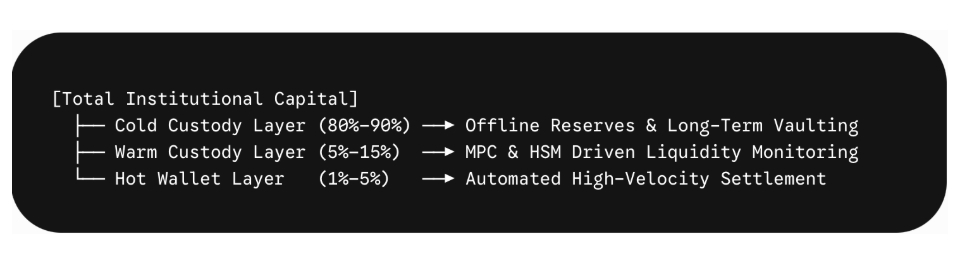
Capital moves seamlessly between these tiers via automated balancing protocols. When the hot wallet layer drops below a pre-set low-watermark threshold, the system triggers a secure transfer from warm storage to replenish the operational pipeline. On the other hand, if an unusually large withdrawal wave hits the hot wallet, automated velocity controls immediately freeze the asset flows to initiate multi-department compliance reviews.
Risk Management of Hot Wallets in a Custody Stack
Designing an effective defense system requires evaluating the primary threats targeting online environments:
- External Server Intrusions: Adversaries exploiting API logic, network vulnerabilities, or zero-day exploits to compromise memory data or hijack signing permissions.
- Internal Insider Threats: Privileged developers or operations personnel abusing their administrative access to execute unapproved transfers.
- Third-Party Supply Chain Vulnerabilities: Dependencies on unvetted software libraries, compromised hosting providers, or external data feeds that compromise the wallet interface.
Engineering Best Practices for Hot Wallet Security
To safely anchor hot wallets within an institutional custody perimeter, engineering teams deploy a robust defense stack:
- Hierarchical Key Derivation: Master private keys stay locked within hardened offline HSMs. Active hot wallets utilize child keys derived via hierarchical deterministic (HD) architectures. If a sub-key is compromised, the damage is strictly isolated to that specific sub-account’s balance, leaving the master root key completely untouched.
- Strict Destination Whitelisting: The hot wallet engine is restricted to executing transfers to pre-vetted destination addresses. Registering a new address requires passing multi-party corporate approvals and triggers a mandatory 24-to-48-hour operational cooling-off period before funds can move.
- Velocity Throttling and Volume Caps: Systems implement strict rate-limiting policies, establishing spending ceilings per single transfer, per minute, and per day. Any outlays crossing these thresholds automatically pause the payment pipeline for manual compliance review.
- Automated Key Rotation: Online signing keys are configured with tight expiration intervals (e.g., 30 days). Upon expiration, the system automatically spins up fresh keys, moves the residual balances, and securely destroys the legacy material to minimize the exploit window for attackers.
Architectural Integration: The Unified Policy Engine
To eliminate operational silos, modern custody frameworks build a Unified Key Management Layer. This software engine abstracts the underlying key profiles—whether hot, warm, or cold—completely hiding the infrastructure complexity from the front-end apps.
This layer presents unified API signature endpoints to your internal business applications. Programmatic trading scripts or payment flows do not need to check where a key is hosted; they simply call the endpoint, and the policy engine automatically applies the matching security checks, validation gates, and compliance rules required for that safety tier.
Continuous Auditing, Compliance, and Transparency
Real-Time Encryption Logs
Enterprise systems require deep visibility into automated systems. Every signing request captures a complete metadata footprint, including the initiator’s identity, device fingerprints, IP location data, and associated internal ticket IDs. These logs are written into immutable, write-once-read-many (WORM) storage environments, ensuring the tracking data cannot be edited or deleted by internal administrators.
Incident Containment Protocols
When defensive layers detect an anomaly, the infrastructure triggers automated incident response workflows:
- Immediate Execution Freeze: The system calls emergency APIs to instantly halt all active hot wallet signing capabilities across the network.
- Root Cause Extraction: Engineers analyze system snapshots and audit logs to isolate the exposure vector—identifying whether it stems from leaked API credentials, an external server exploit, or insider collusion.
- Emergency Capital Extraction: Any residual funds left in the hot environment are swept immediately into a secure, pre-configured offline backup destination.
Industry-Specific Implementations
High-Volume Digital Asset Exchanges
Exchanges handle massive, high-concurrency transaction environments with complex retail user deposits. Their custody setups deploy a multi-wallet isolation strategy, separating capital into independent accounts based on asset type, user tier, and business lines. This contains the blast radius of any individual exploit, while automated withdrawal queues match payments directly against real-time user verification checks.
Merchant Payment Processors
Payment rails handle massive volumes of low-value, high-frequency transactions. These platforms isolate their automated signing code into dedicated microservices, strictly separating the cryptography from the general business logic layer. They implement a settlement pool design, batching individual merchant payouts into scheduled clearing intervals to optimize gas fees and minimize live signing frequency.
Institutional Asset Allocators and Wealth Desks
For family offices and corporate treasuries managing active yield strategies, hot wallets serve as secure access points for smart contract trading. They run a linked-account framework, using the hot wallet strictly as a front-end terminal with limited capital, while keeping the main treasury reserve locked safely in air-gapped cold storage.
Next-Generation Security Technologies
- Trusted Execution Environments (TEEs): Running hot wallet code inside isolated hardware safe zones (Enclaves). Private key data is decrypted and executed strictly within the chip’s local memory, ensuring that even if an attacker compromises the primary operating system or server hypervisor, they cannot read the secure enclave’s memory.
- Distributed Off-Chain MPC Sharding: Multi-Party Computation is changing hot wallet design by sharding the private key material across separate online nodes at inception. Co-signing happens via distributed off-chain math, ensuring a single compromised server node cannot single-handedly drain corporate capital.
- Predictive, AI-Driven Wind-Down Systems: Incorporating machine learning models into the treasury pipeline to continuously analyze on-chain behavior graphs, network threat levels, and wallet forensics. If risk metrics spike, the AI automatically dials down hot wallet spending caps and triggers extra multi-factor validation checks ahead of schedule.
Balancing Operational Speed and Structural Safety
In professional digital asset operations, prioritizing security by completely avoiding hot wallets halts business efficiency, while running unmonitored hot applications exposes the company to unacceptable capital risks. Mature asset management is about balancing these two requirements—understanding your threat parameters and deploying a layered framework that bounds hot workflows within strict corporate guardrails.
The connection between hot wallets and professional asset custody is a continuous balance between operational speed and system resilience. By combining tiered architectures, automated balancing engines, and immutable audit logs, modern institutions can turn hot wallets into safe, high-powered engines—driving business growth while staying securely wrapped within an institutional defense perimeter.
Disclaimer: This content is for informational and educational purposes only and does not constitute technical configuration, product selection, or investment advice. Always conduct comprehensive internal security audits and professional risk assessments before deploying advanced cryptographic infrastructure.