


Hot Wallets and Asset Custody: Balancing Efficiency and Security in Digital Finance
As the digital asset market matures, securing, managing, and storing on-chain assets has become a foundational challenge for companies, institutional allocators, and individual users alike. From standard token trading and cross-border settlement to active Web3 dApp interactions, asset management forms the critical baseline infrastructure of the blockchain economy.
Within this framework, Hot Wallets 及 Asset Custody serve as two central, closely related concepts. Hot wallets handle the immediate needs of real-time transactions and daily liquidity operations, while comprehensive asset custody frameworks secure long-term capital and enforce organizational risk controls.
For digital asset exchanges, Web3 native startups, investment funds, and enterprise treasuries, the defining operational challenge is discovering how to optimize fund liquidity without compromising asset security. This guide explores the core architecture, trade-offs, and future trajectories of hot wallets and professional asset custody infrastructure.
What is a Hot Wallet?
A hot wallet is an online digital asset management system connected directly to the internet and configured to process real-time blockchain transactions automatically.
Key Operational Characteristics
- Persistent Network Availability: Stays continuously connected to internet protocols and active blockchain nodes.
- Instant Execution Velocity: Supports rapid, automated outbound payouts and clearing.
- High Liquidity Flow: Minimizes settlement lag to keep corporate capital highly mobile.
- Streamlined Connectivity: Integrates smoothly with Web3 protocols, smart contracts, and decentralized platforms.
As hot wallets interface natively with live blockchain networks, they serve as the primary operational engines for day-to-day transaction processing, retail user cashouts, and platform liquidity runs.
How Hot Wallets Execute Transactions
Hot wallets store cryptographic key material locally within an online database or server memory, maintaining a live pipeline to network nodes. The execution lifecycle runs through four distinct phases:
User Initialized Transfer⟶Automated Hot Wallet Sign⟶Network Broadcast⟶On-Chain Confirmation
As this loop routes programmatically off-chain before pushing to the ledger, transactions clear in seconds, making hot wallets a structural requirement for high-concurrency business applications.
What is Asset Custody?
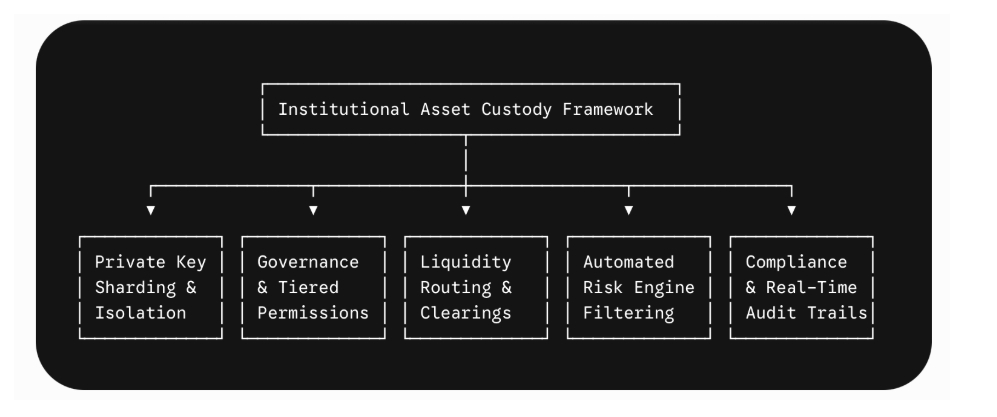
In the digital asset ecosystem, Asset Custody represents far more than simple passive storage. It is an integrated institutional framework designed to safely store, isolate, audit, and govern on-chain capital.
Professional custody shifts the focus away from simple key management toward comprehensive organizational risk mitigation. It requires building reliable guardrails across five core operational layers:
The Drivers Behind Institutional Custody Adoption
- Exponential Capital Scaling: As traditional funds, neo-banks, and public companies allocate capital to digital assets, managing vast corporate treasuries internally becomes an unacceptable liability, driving demand for specialized institutional custodians.
- The Complexity of On-Chain Threat Vectors: While 24/7 global markets maximize settlement speed, they also expose unvetted systems to highly sophisticated remote exploits, phishing syndicates, and internal employee collusion.
- Tightening Global Regulatory Mandates: Regulatory frameworks worldwide require modern digital asset enterprises to implement independent asset segregation, verifiable internal control tracking, and auditable liability trails to prevent fraud and ensure investor protection.
The Functional Value of Hot Wallets in a Custody Stack
A common misconception is that institutional asset custody relies exclusively on offline cold storage vaults. In practice, a comprehensive corporate treasury framework requires both hot and cold architectures to manage capital effectively. Hot wallets serve as the essential liquidity layer within a mature custody stack.
Accelerating Daily Capital Settlement
Enterprises must process high-concurrency loops daily—including real-time user withdrawals, automated merchant clearings, cross-border vendor payments, and internal portfolio rebalancing. Forcing these routine actions through air-gapped cold storage would stall operations. Hot wallets automate these workflows, keeping business operations agile.
Powering Web3 Protocol Interaction
Modern digital treasuries do not just hold assets passively; they deploy capital to maximize yield. Participating in DeFi lending pools, interacting with staking contracts, and executing decentralized token swaps require automated, high-frequency cryptographic signing—a structural capability that only an online hot wallet layer can deliver.
Addressing Hot Wallet Security Challenges
While hot wallets deliver exceptional transaction speed, their persistent network exposure introduces distinct security vulnerabilities:
- Online Network Exploits: Keeping key material on internet-facing servers makes hot wallets a primary target for remote malware injections, API abuse, or server-side intrusions.
- Static Master Key Vulnerabilities: Legacy hot wallets store complete, unified private key files within server environments. If an attacker breaches the local database, the key can be scraped and the portfolio drained instantly.
- Internal Collusion and Insider Risk: If single hot wallet instances grant unchecked administrative clearance, an organization remains highly exposed to rogue employees or compromised local credentials.
To mitigate these risks, modern custody platforms implement a Layered Architecture Model, separating corporate treasury operations into distinct functional layers.
| Layer | Core Responsibility | Security Focus | Performance Metric |
| Hot Wallet Layer | High-velocity payments, routine cashouts, and DeFi plays | API security and rate-limiting limits | Millisecond execution |
| Cold Vault Layer | Long-term asset preservation and reserve vaulting | Total physical and network isolation | Manual, multi-hour approvals |
| Risk Mitigation Layer | Address filtering and velocity monitoring | Catching anomalous smart contract behaviors | Real-time automated screens |
| Corporate Audit Layer | Recording logs, tracking history, and compliance sheets | Immutable record keeping | Full historic transparency |
Designing an Enterprise Custody Model
Implement Tiered Capital Separation
Firms should maintain an optimized balance between safety and liquidity by never storing their entire treasury pool in a single hot wallet environment. Keep 80% of core assets isolated in air-gapped cold storage, routing only 20% of operational capital into your online hot layer to cover immediate transaction runways.
Enforce Multi-User Role-Based Permissions
Deconstruct administrative power by assigning distinct roles across your treasury operations. Ensure no single employee can initiate, review, and execute a transfer unilaterally. Separate tasks clearly between finance initiators, risk compliance reviewers, and executive clearers.
Integrate Multi-Device Approval Gates
High-value payouts should automatically trigger multi-party approval loops before cryptography can execute. This significantly reduces human operational errors and ensures that a compromise at a single employee endpoint cannot single-handedly drain corporate capital.
What’s Next in Asset Custody
Mass Adoption of Multi-Party Computation (MPC)
To completely eliminate the risk of static master key leaks, enterprise custody platforms are phasing out traditional single-signature hot wallets. Modern setups run non-custodial MPC engines, sharding the key material into independent mathematical fragments across separate perimeters at inception. Transactions are co-signed off-chain, ensuring a complete key file never exists in server memory.
Automated, AI-Enhanced Risk Routing
Future custody systems are embedding real-time machine learning modules directly into the automated hot wallet signing pipeline. These algorithms analyze transaction velocities, destination risks, and contract addresses instantly, automatically flagging and halting anomalous payments before the key shares can execute.
Unified Universal Multi-Chain Portals
As the Web3 landscape fragments across diverse layer-1 and layer-2 protocols, institutions require a centralized command center. Modern custody setups prioritize universal asset management, allowing corporate finance teams to track balances, audit histories, and manage assets across multiple public networks inside a single dashboard.
Balancing Operational Speed and Structural Safety
Hot wallets and institutional asset custody are not competing concepts; they are complementary components of a complete corporate risk framework. Hot wallets provide the liquidity and automated velocity required to run a modern, scalable digital business, while professional custody platforms establish the necessary risk controls, compliance tracking, and layered safety perimeters to keep long-term reserves safe.
For individual investors, picking the right setup simply streamlines daily portfolio plays. However, for modern enterprise teams and Web3 corporations, building a robust, tiered custody architecture is a structural requirement for business continuity. As security technologies advance and regulatory frameworks crystallize, combining the automated speed of hot environments with the distributed protection of professional custody will become the standard foundation for the digital economic era.
Disclaimer: This content is for informational and educational purposes only and does not constitute technical configuration, product selection, or investment advice. Always conduct comprehensive internal security audits and professional risk assessments before deploying advanced cryptographic infrastructure.