


As blockchain technology and digital assets experience rapid adoption, companies, institutions, and individual users face a critical operational challenge: how to securely store, transfer, and manage on-chain capital.
Within this landscape, Hot Wallets serve as the primary execution tools for everyday operations, while Asset Custody provides the essential framework for security and regulatory compliance. Together, they form the two foundational pillars of digital asset management—balancing operational efficiency with capital security.
Understanding the technical boundaries of hot wallets, the compliance value of professional custody, and the mechanics of how they operate together is a necessity for establishing a secure, efficient, and compliant corporate treasury framework.
Hot Wallets: The Operational Gateway for Digital Liquidity
A hot wallet is an online digital asset management system connected directly to the internet, configured to process real-time cryptographic signatures and blockchain transactions. Unlike cold storage systems that focus purely on long-term vaulting, hot wallets are engineered for immediate convenience, speed, and continuous availability.
Technical Engineering and Execution Logic
At the infrastructure layer, hot wallets focus on online key management and real-time transaction clearing. Presented via software applications, web interfaces, or API clients, hot wallets store encrypted cryptographic keys directly on network-connected devices or servers.
When an output command—such as a token transfer, smart contract interaction, or protocol approval—is initialized, the pipeline executes seamlessly online:
Identity Verification⟶Transaction Initialization⟶Automated Online Signing⟶Network Ledger Broadcast
While early hot wallet architectures stored single private keys directly in server databases, modern versions combine Multi-Party Computation (MPC) and Threshold Signature Schemes (TSS) to create secure, distributed keyless frameworks. However, the core nature of persistent, real-time connectivity remains identical, allowing transactions to clear in seconds.
Core Business Advantages
- High Operational Efficiency: As the framework stays continuously online, teams bypass the manual friction of air-gapped hardware configurations. Outbound transfers and smart contract interactions process instantly, meeting the speed demands of quantitative trading desks, digital asset exchanges, and cross-border payment networks.
- Broad Protocol Compatibility: Enterprise hot wallets go beyond standard asset transfers. They feature multi-chain compatibility, automated portfolio aggregation, bulk transfer processing, and deep API capabilities that integrate directly with existing corporate ERP and accounting software.
- Turnkey Deployment and Lower Overhead: Setting up a hot wallet requires zero specialized hardware or complex physical security infrastructure. Companies can deploy via sandboxed software or cloud instances, ensuring agile technical updates and lower ongoing maintenance costs.
Primary Use Cases
- Exchange Liquidity Pipelines: Automating high-concurrency retail deposits and user withdrawal queues.
- Decentralized Finance (DeFi) Trading: Interacting with on-chain lending protocols, automated market makers (AMMs), and staking smart contracts.
- Daily Corporate Outlays: Executing routine vendor clearings, programmatic operational payouts, and automated supply chain settlements.
Inherent Vulnerabilities and Operational Limitations
The cost of real-time convenience is an increased remote attack surface, making hot wallets inherently unsuited for long-term vaulting:
- Persistent Remote Threats: Active network connectivity leaves hot wallets exposed to server-side intrusions, zero-day web exploits, API hijacking, and advanced malware campaigns.
- Code and Structural Vulnerabilities: Flaws in contract logic, unverified dependencies, or weak key isolation mechanisms can give remote adversaries a direct exploit window.
- Human Operational Risks: The speed of online execution makes hot wallets highly vulnerable to human errors—such as incorrect address inputs or accidental approvals of malicious contracts—with zero recourse for capital recovery.
- Weak Independent Compliance Control: Native hot wallets lack built-in corporate governance features, multi-tier compliance reviews, or immutable auditing logs, leaving firms exposed to regulatory risks.
Asset Custody: The Core Infrastructure for Safety and Compliance
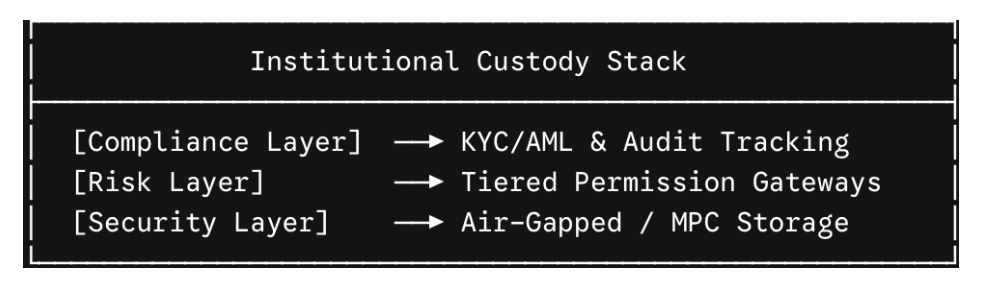
Originating from traditional finance, asset custody requires safekeeping, clearing, and governing capital via an independent framework. In the digital space, Asset Custody represents a comprehensive service model delivering secure asset storage, structured permission controls, automated transaction review, and unalterable auditing. It serves as the definitive defense perimeter and compliance foundation for institutional digital wealth.
The Institutional Value of Digital Custody
Unlike legacy finance, where custodians hold physical certificates or claims, digital custody focuses on protecting the underlying cryptographic key material. It delivers value across three core areas:
- Hardened Capital Preservation: By replacing individual key storage with institutional security perimeters, custodians engineer out the risks of lost mnemonic backups, device damage, and single-key phishing hacks.
- Turnkey Regulatory Alignment: Custodians build structured identity checks, multi-tier corporate approvals, and unalterable transaction histories into the workflow, allowing entities to satisfy strict global transparency and anti-money laundering (AML) laws.
- Professional Cash Management: Providing advanced accounting sheets, real-time balance data, automated risk profiling, and structural asset isolation tailored to multi-department enterprise hierarchies.
Custody Architectures and Core Technology
- Air-Gapped Cold Storage: Keys are generated and permanently isolated on physical hardware components completely disconnected from internet routing. Transactions require manual, physical data transfers via offline media. This setup offers the highest possible security but low execution speed, making it the preferred format for long-term reserve vaulting.
- Hybrid Cold/Hot Frameworks: Splitting a corporate treasury into distinct pools: routine operational funds reside in an automated online layer, while the bulk of core capital sits within cold vaults, managed via programmatic balancing rules.
- Distributed Cryptographic Custody: Utilizing Multi-Party Computation to shatter the private key into independent mathematical shares across separate endpoints. Signatures are calculated off-chain without ever compiling a complete key string, balancing security with transaction speed.
Building a Unified Capital System
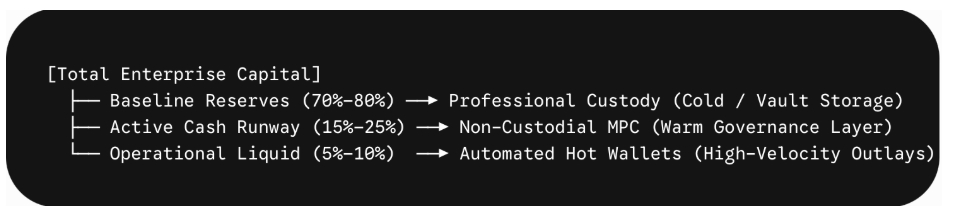
Hot wallets and professional asset custody are not competing formats; they are complementary components of a mature corporate risk framework. By combining the speed of online signing with the strict guardrails of professional custody, organizations can eliminate single points of failure without introducing operational friction.
Layered Capital Allocation
Enterprises should segregate their digital treasury into clear functional tiers based on liquidity velocity and transaction frequency:
Automated Balancing and Velocity Controls
To prevent hot wallet balances from drying up or accumulating excess exposure, companies configure smart rebalancing rules within their custody framework:
- Automated Capital Replenishment: When the hot wallet drops below a pre-set low-watermark threshold, the custody engine automatically runs an approved compliance check to route funds from the vault layer.
- Excess Capital Sweeps: If an influx of user deposits causes hot wallet balances to cross a high-watermark ceiling, the excess capital is automatically swept back into secure cold isolation, minimizing the active online attack surface.
- Emergency Wind-Down Protocols: If the system flags an anomalous withdrawal pattern or unauthorized contract interaction, automated risk engines instantly freeze hot wallet signing capabilities, allowing engineers to contain threats and sweep residual capital to backup environments safely.
Unified Interface and Audit Integration
Firms should integrate their hot wallet endpoints and institutional custody vaults into a single administrative platform. This unified layer enforces identity verification across all movements, tracks real-time balance metrics, and outputs unalterable, write-once-read-many (WORM) audit logs to ensure flawless corporate transparency.
Key Implementation Criteria for Enterprise Teams
When designing and deploying a digital asset treasury model, corporate risk officers must evaluate solutions across four primary dimensions:
- Cryptographic Integrity: Confirm that hot wallet interfaces utilize mature, audited libraries (such as standardized MPC-TSS code). Ensure the custodian’s storage frameworks feature zero single-key dependencies and maintain rigorous isolation standards.
- Operational Adaptability: The permission architecture must naturally match your corporate structure. Look for platforms that support granular role-based access control (RBAC), allowing you to build custom approval workflows, geographic separation gates, and flexible value thresholds.
- Turnkey Compliance Infrastructure: Prioritize systems that embed automated user onboarding (KYC), real-time transaction screening (AML), and tamper-proof historic data exports that interface seamlessly with external corporate auditors and regional regulators.
- Infrastructure Resilience and SLAs: Evaluate the technical capability and market pedigree of your custody partner. Ensure they offer high-availability node distribution across separate cloud backends, comprehensive physical disaster recovery lines, and professional service level agreements (SLAs).
Balancing Settlement Agility with Structural Safety
Hot wallets and professional asset custody form a complete operational loop for modern digital finance. Hot wallets solve the problem of execution speed, keeping capital highly mobile to drive business growth. Professional custody solves the problem of capital preservation, ensuring assets stay fully protected and compliant with global financial regulations.
For any institution operating within the digital economy, building a layered architecture that merges these two components is a requirement for long-term business continuity. By deploying a model where hot wallets handle high-velocity operations under the continuous protection of a comprehensive custody framework, enterprises can eliminate single points of failure—driving real-time operational efficiency without sacrificing capital safety.
Disclaimer: This content is for informational and educational purposes only and does not constitute technical configuration, product selection, or investment advice. Always conduct comprehensive internal security audits and professional risk assessments before deploying advanced cryptographic infrastructure.